Introducing GKE agentic migration for AI-assisted EKS-to-GKE migrations with built-in governance
Enterprises are increasingly standardizing on Google Kubernetes Engine (GKE) to run their most critical and

Entire database engineering careers have been spent on a single question: How do you scale an OLTP workload without compromising the system of record that owns the data?
Exadata answered the question by offloading queries into a scale-out storage tier beneath the database, removing the network as the bottleneck. Azure SQL Hyperscale did it with shared block servers, scaling out to tens of read replicas. Aurora offloaded log application to distributed storage nodes, scaling reads across tens of PostgreSQL nodes. Meanwhile, emerging architectures persist data in traditional object storage with a provisioned cache tier in front, recovering latency for hot data but leaving a high-latency tail on every cache miss.
Each of these architectures is inherently constrained by at least one of these three properties: scale, latency, and isolation — and sometimes even two. For instance, architectures built on shared block servers compromise scalability, because I/O inevitably bottlenecks on the block server. They also sacrifice isolation, as production workloads get throttled whenever replica traffic spikes.
Some of these trade-offs were actually sound at the time; they met the requirements of enterprise database workloads for four decades. However, in the agentic era, these compromises are no longer acceptable. Agentic workloads are generated dynamically and cannot be vetted in advance, making it a business-continuity imperative to isolate them from mission-critical systems. Agentic workloads also require low latency that is only possible with the full power of the database engine and all its indexes, as well as a a whole new level of elastic scale that has never been tried with a single database: a burst of agents that demand 1,000 compute nodes over a single database within seconds, and that may finish inside a minute.
We believe the agentic era demands a new agentic database architecture defined by three fundamental tenets. An agentic database architecture must satisfy all three, or it isn’t really agentic.
Tenet: Isolation — isolation by design, but with real-time data access. Agents must read live production data with sub-second freshness over a data path that does not share database components with the primary cluster. Real-time means up-to-the-second, not a stale copy or branch. This is physical separation, not a quota — because shared allocations mean shared fate. The boundary extends straight through the storage layer, eliminating resource contention by design.
Tenet: Latency — sub-millisecond baseline I/O. Operational workloads demand sub-millisecond block I/O, and that bar does not drop for agents. While compute nodes leverage DRAM and local SSD for acceleration, cache misses that reach remote storage — whether application or agentic — must complete in under a millisecond. An architecture that degrades into an order-of-magnitude performance cliff is fundamentally unusable by agents.
Tenet: Scale — agent-scale compute and I/O. Agent scale is simultaneously instantaneous, volatile, and massive: Database compute nodes must spin up in seconds, scale to thousands, run for short bursts, and automatically spin down to zero when agents are done with them. No one has thus far ever dreamed of expecting a database to scale compute and I/O dynamically to thousands of nodes while leaving production untouched. Due to the dynamic nature of agents, pre-provisioning is a non-starter across the entire stack, whether it’s compute, storage I/O, or any caching tier in between.
Crucially, an agentic architecture must uphold all three tenets at once. And by doing so, the architecture allows agents to work directly against live operational data, i.e., enterprise truth, without compromising production stability. The outcome is transformative:
No correlated failures: Total decoupling between the engines running the business and the fleets of agents reasoning over it removes a path for agents to affect production.
No capacity guesswork: True elasticity that eliminates the friction of pre-provisioning for unforecastable agent scale.
No semantic compromises: Nothing is withheld from agents — they get access to the full power of relational SQL, hybrid search (vector, full-text, spatial), and indexes within every single reasoning step.
AlloyDB’s new agentic database architecture is the first system that satisfies all three tenets. We engineered this from the ground up across storage, network, compute and databases to deliver:
Isolation, avoiding shared fate by design: The transactional production cluster runs on dedicated, pre-provisioned infrastructure, completely isolated from agent workloads. Agents interface via the Model Context Protocol (MCP) to an independent, ephemeral pool of microVM-based AlloyDB nodes that read directly from dedicated Colossus storage segments, separate from those for production.
Predictable sub-millisecond storage I/O: Every storage read is served directly by Google’s Colossus storage system inheriting its baseline sub-millisecond latency, eliminating performance cliffs on cold cache misses.
True zero-to-thousands compute scaling: The agent pool scales rapidly from zero to thousands of nodes for bursty agentic activity, and scales back to zero the moment tasks complete.

Agents query production data with sub-second freshness, with the complete PostgreSQL engine — point lookups, index traversals, vector, full-text and spatial search, columnar scans, and federated queries across the lakehouse — at their disposal to power their reasoning loops.
Traditional and emerging operational databases attempt to scale using one of three architectural paradigms. When assessed against the demands of autonomous AI agents, each paradigm exhibits a fundamental structural compromise — none satisfies all three tenets simultaneously.
Traditional relational architectures scale reads by streaming replication logs from a primary instance to dedicated replica databases, each with its own local or attached block storage. They meet Tenet: Isolation – replicas share no physical resources with the primary cluster, and continuous log replication maintains near-real-time currency. They meet Tenet: Latency – dedicated local storage guarantees predictable, sub-millisecond read latency. However, they fail Tenet: Scale – scaling requires provisioning a new replica and rehydrating hundreds of gigabytes or terabytes of storage. All this takes hours — an impossible mismatch for agent-reasoning bursts measured in seconds. Furthermore, statically provisioned compute and storage continue to incur idle costs long after the agent completes its run.
A second approach decouples stateless compute nodes from a shared, multi-tenant tier of custom storage servers that manage persistence, replication, and that may offload block writes. This approach meets the Tenet: Latency – reads hitting the optimized storage servers resolve with consistent, low operational latency. However, it fails the Tenet: Isolation – because every replica reads from the same servers as the primary, so agent I/O contends directly with production I/O, creating shared fate. It also fails the Tenet: Scale – stateless compute replicas spin up quickly because no data is copied, but total storage I/O bandwidth is fixed to the pre-provisioned storage tier. Adding compute nodes without scaling underlying I/O capacity simply accelerates storage saturation and throttling.
A third emerging approach keeps data durable in general-purpose object storage and serves block reads from a shared tier of block servers. Because a random read from object storage takes tens of milliseconds — an order of magnitude slower than traditional database storage, and slower than an enterprise disk array has been for at least 25 years — the block servers hold hot data in order to serve it at low latency. This approach meets the Tenet: Latency — with one caveat: A block server miss still falls through to object storage at unacceptably high latency. It fails the Tenet: Isolation — because replicas share the block servers with production: Agent I/O and production I/O draw on the same capacity, so when that capacity is exhausted or throttled, production is affected along with the agents. It also fails the Tenet: Scale, for the same reason as shared storage servers: Replicas start quickly, but the block servers do not scale their I/O with the burst.
Some architectures in this family also allow analytical engines like Apache Spark to read the underlying object storage directly, bypassing the database engine. For analytics workloads, that is a valuable and viable path. However, since agents need low-latency retrieval, stripping away indexes, point lookups, and vector search forces brute-force table scans, exploding latency, and therefore breaks the ability for agents to execute their retrieval-reasoning loops.
We evaluated a commercially available service that uses the object storage architecture with shared block servers by running concurrent index lookups over a dataset larger than available DRAM, testing both scaling limits and production isolation. Starting with a single reader instance, we scaled the workload by adding up to eight read replicas.
In architectures with shared physical resources, scaling agents via read replicas quickly degrades both replica and primary performance. In our tests as seen in the chart below, adding replicas provided less than a 2x throughput increase, peaking at four replicas before dropping off as the shared block-server bandwidth saturated.

The impact on the primary database was immediate and severe: Primary throughput plummeted by more than 75% as replicas were added.

In short, neither traditional nor emerging architectures can meet the scale that agents demand, and certainly not without jeopardizing the stability of production systems.
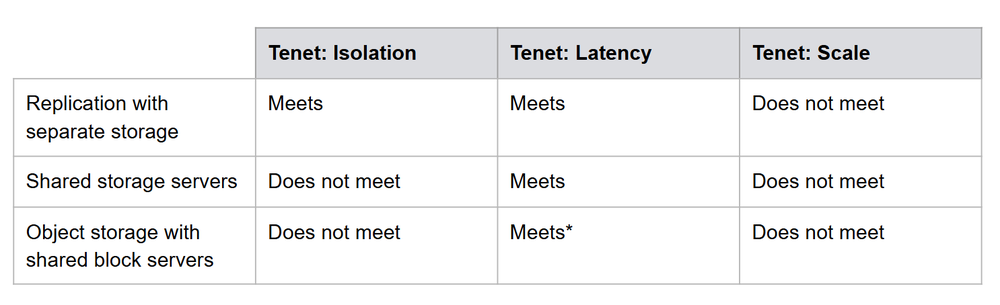
* Partially meets: Hot data is served at low latency from the block servers, but a block server miss falls through to object storage at tens of milliseconds.
In each case the gap is structural, not just a matter of tuning. Replication isolates by giving each replica its own storage, so it cannot add a replica faster than it can populate that storage. Shared storage servers add compute quickly by sharing storage, so they can neither isolate nor scale I/O. Block servers over object storage recover latency with a provisioned tier, so they can neither isolate nor burst, and every miss still reaches object storage. Each approach solves the problem at one layer and pays for it at another. Meeting all three tenets at once requires rethinking the database architecture across compute, network and storage together.
AlloyDB’s agentic database architecture is vertically integrated across Google’s data, AI and infrastructure stack: AI models, the database engine and analytical engines, but also storage, networking and compute infrastructure.
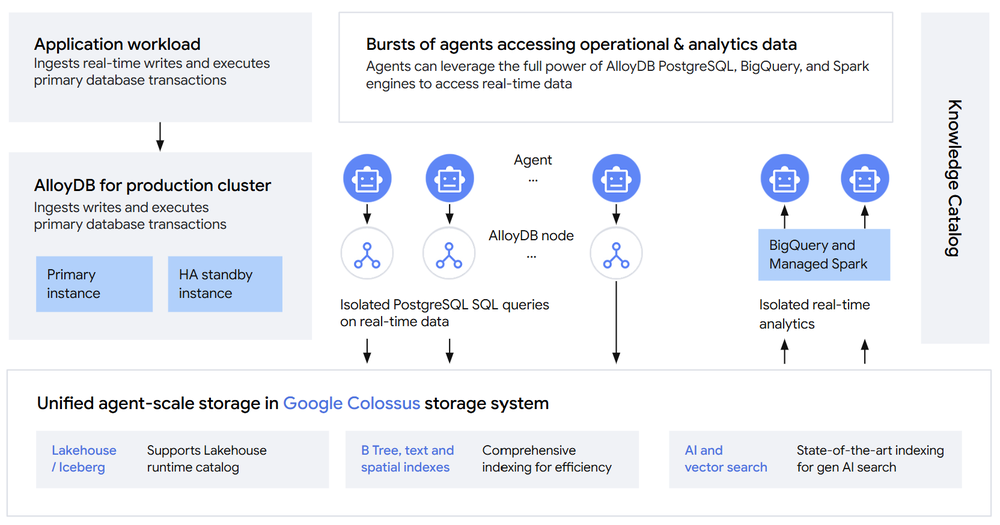
At the persistence layer, AlloyDB builds on Colossus, Google’s exabyte-scale distributed storage system that underpins Google Search, YouTube, Gmail, Google Drive, Spanner, and Bigtable. A single Colossus cluster scales to exabytes of storage and tens of thousands of machines. With Spanner, we demonstrated that a transactional database engineered directly on Colossus can scale to thousands of nodes. The new AlloyDB architecture applies the same foundation to a new problem: agents.
Colossus has three properties that enable AlloyDB to satisfy the three tenets.
Direct, sub-millisecond I/O: Colossus is engineered to minimize read latency. A database node opening a Colossus stream receives a handle that describes where data physically resides. Authorization and metadata resolution happen once, when the stream is created; every subsequent read goes directly to the disks holding the data, over an optimized network protocol. The result is sub-millisecond latency across all of the database’s data, with no intermediary to warm and no tier to miss.
Massive throughput: Colossus delivers up to 15 TB/s of aggregate throughput and 20 million queries per second to a single AlloyDB database without needing to provision bandwidth and with an unlimited number of concurrent hosts. At Colossus scale, a fleet of AlloyDB agent nodes is not a load the storage must be sized for; it is a fraction of the load the storage already serves!
Physical segment partitioning: AlloyDB serves agents from a separate set of Colossus segments, so agent I/O is deliberately spread away from the production data path rather than contending with it.
At no point along the data path — compute, network or storage — can an agent ever share a database component with production.
Compute and storage are bound together by Jupiter, Google’s high-capacity data center network. A single Jupiter fabric connects more than 100,000 servers with 13 petabits per second of bisection bandwidth — enough to carry a video call for every person on Earth.
Because Jupiter provides high bisection bandwidth with predictable low latency across the networking fabric, agent nodes can be scheduled flexibly anywhere in the cluster with consistent access to centralized storage. As the agent pool scales from zero to thousands, the underlying interconnect capacity absorbs the expanding traffic without creating placement bottlenecks
At the compute layer, agents connect to AlloyDB’s agent pool through MCP. The agent pool consists of AlloyDB agent nodes with read-only access to the up-to-second state of the database. This layer provides:
MicroVM isolation: Each agent node is a fully functional AlloyDB for PostgreSQL database engine running inside a lightweight, secure microVM. These instances are fully isolated from each other and from the dedicated primary cluster.
Rapid spin-up and scaling: Agent nodes are provisioned in response to requests from agents and stop automatically when the agents finish. In response to a burst, AlloyDB rapidly provisions thousands of agent nodes, serving millions of concurrent agents, and releases them as the agents finish. Because billing is per second of agent-node activity, a burst that uses a thousand nodes for tens of seconds will only be charged for the resources that the job consumed, and nothing more.
Meanwhile, the production cluster remains as it is today: pre-provisioned, on dedicated infrastructure, sized for the system of record. Agent nodes read from Colossus directly and see a consistent production state with sub-second freshness.
Beyond the agent pool, BigQuery and Spark can read AlloyDB data from Colossus with the same isolation from the production cluster, so agents can use lakehouse federation to join real-time operational data with large-scale lakehouse datasets.
By building on these Google-scale storage, network, and compute layers, AlloyDB’s new agentic database architecture achieves a remarkable goal: Share the data. Share nothing else.
We tested AlloyDB by running concurrent index lookups over a dataset larger than available DRAM, testing scalability across the full stack. We ran the agentic workload starting with a single agent node — an independent database instance in the agent pool, rather than a traditional read replica — and scaled dynamically to thousands of nodes over a single database, measuring both the aggregate agentic throughput as well as any impact on production.
In this test, throughput scaled linearly from 3.9K to 41K QPS when expanding from one to 10 agent nodes. Scaling by two additional orders of magnitude yielded near-linear performance up to 1,000 nodes. We observed:
Zero primary degradation: Scaling from 1 to 1,000 agent nodes produced no measurable impact on primary cluster performance.
Massive throughput: Aggregate throughput dynamically scaled 773x to 3 million QPS, driving over 8 million IOPS in Colossus across 1,000 compute nodes.
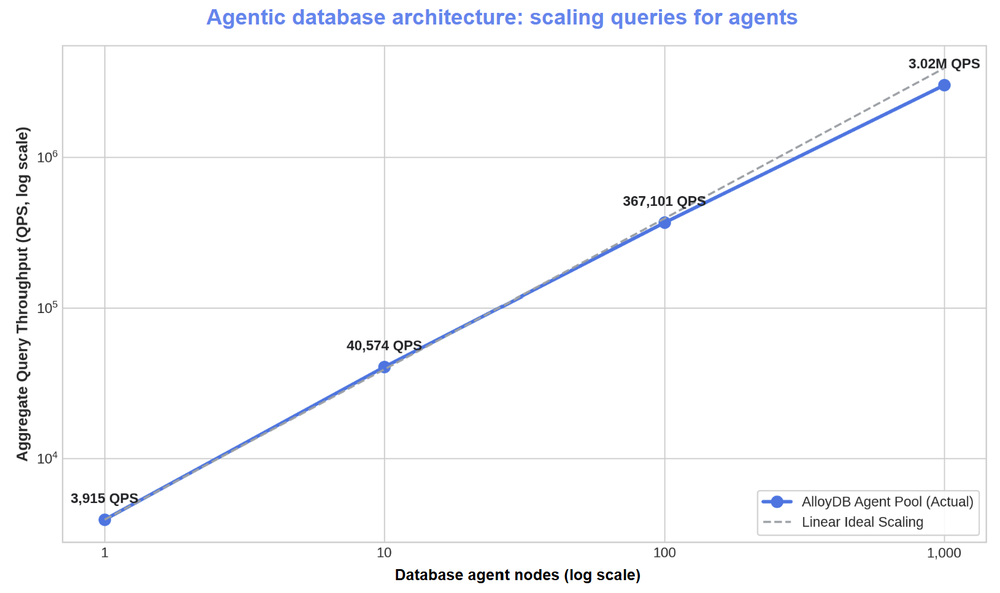
In a similar benchmark running concurrent full table scans across 2,100 agent nodes, aggregate scan throughput exceeded 1 terabit per second.
Because the agent pool shares no physical infrastructure with the production cluster, teams can scale reasoning fleets to thousands of nodes without placing production systems at risk.
The table below shows how AlloyDB’s architecture satisfies each of the three tenets:
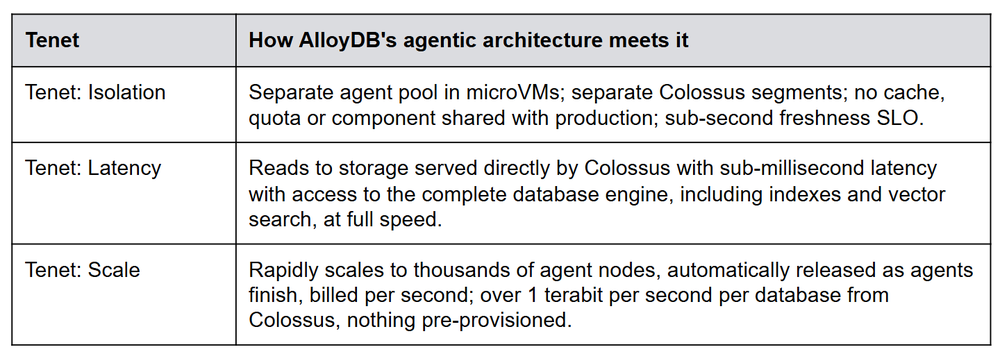
Every agentic database architecture will require these three foundational elements: storage with the properties of Colossus, a network that connects compute to that storage without constraint, and compute that can be provisioned and released at agent scale.
Google has spent more than two decades building exactly that, to run Google Search, YouTube, and Gmail. Now it underpins our agentic database architecture.
Every organization building with AI faces the same core dilemma: how to give agents full access to live operational data without putting the systems running the business at risk. Until now, architecture — not application needs — dictated that choice. Giving agents direct access to the database meant exposing mission-critical systems to unforecastable load, severe resource contention, and production outages.
An architecture built on these three tenets removes these compromises entirely. Agents reason over live production data withsub-second freshness. They have the complete engine at their disposal — every index, vector, full-text and spatial search, and the full capability of SQL — at sub-millisecond I/O. The architecture scales dynamically to thousands of isolated nodes when agents need it, then to zero when agents finish. Throughout, core transactional workloads remain untouched: no shared components, no shared quota, no correlated failures. Agents can deliver innovation without conflicting with business continuity.
The same property extends to every other reader of production data. Reporting, analytics and applications can freely read live data without putting production at risk, ending a constraint that has shaped operational databases for five decades.
The data in an enterprise’s systems of record is its crown jewels. Built on this foundation, that data can finally be put to work in full.
Databases, unfettered.
To learn more, visit the documentation page, and sign up here to get started.