More efficient and functional workplaces start with smart building data
Smart building data is being used to make buildings more efficient, more responsive, and better

The modern web is extremely visual. People are busy and easily-distracted, and smart companies know they have just seconds to attract would-be customers with compelling images, videos, animations, and other eye-catching elements. That’s why iconic brands like Bugatti, Yeti, Porsche, Spotify, and Sonos rely on Imgix to be the engine driving their online visual media.
Every day, Imgix serves more than 8 billion images and videos for brands like these and many others. With a platform designed to unify media optimization, AI transformation, and global delivery, Imgix ensures that its partners’ digital experiences are fast, personalized, and built for performance. Now more than ever, leading organizations are demanding real-time, high-fidelity media, and they need it to be fast.
To meet that demand, Imgix has evolved its infrastructure from private data centers to a full-stack, GPU-based environment on Google Cloud’s AI Hypercomputer. By transitioning to G4 VMs powered by NVIDIA RTX PRO 6000 Blackwell GPUs, Imgix ramped up its real-time processing capabilities, cutting median latency by 50% and increasing throughput per node by 6x. And it did all of that without changing its core application code.
To capture people’s attention businesses need rich, fast-loading content that can reach millions of users simultaneously across a diverse array of devices.
A big part of that is real-time transformations — resizing, format negotiation, and applying artistic effects — and the computational power required for real-time transformations can be immense.
With inefficient technology, load times can be slow and brands risk giving their users poor experiences. Imgix’s solution to this challenge is a “just-in-time” philosophy. Achieving this requires high-performance instances. And with G4 VMs, they were able to process images instantly upon request rather than pre-rendering and storing millions of image variations.
When companies build on Google Cloud, they get more than just servers: they plug into the same intelligence engine powering Google’s many billion-user products. Imgix is leveraging this structural advantage by using G4 VMs.
G4 VMs incorporate eight NVIDIA RTX PRO 6000 Blackwell GPUs, two AMD Turin CPUs, and Google Titanium offloads, which act as a dedicated administrative assistant for businesses’ servers. They handle the ”office chores” of security and data traffic in the background while the main processor does a company’s heavy lifting.
The G4 VM’s custom P2P interconnect yields up to 168% more throughput than standard configurations. With this architecture, Imgix can move all its image processing operations to NVIDIA GPUs and run multiple requests in parallel.
Imgix offers more than 150 different visual filters and its architecture is built to handle transformation requests dynamically based on which filters users choose. The pipeline has four primary stages:
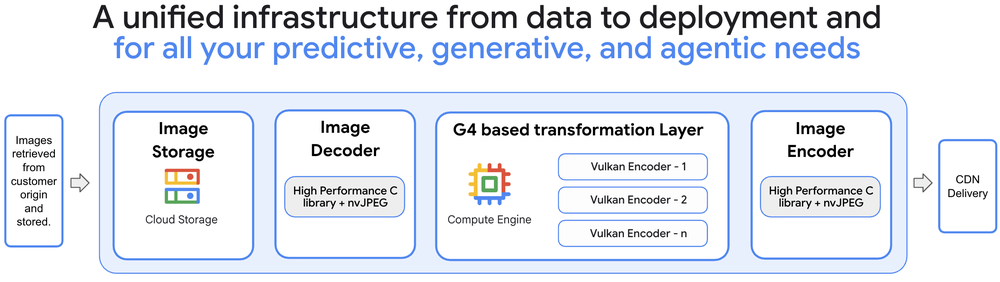
Ingestion: The system retrieves assets directly from customers and routes them to a 2.5 petabyte storage cache on Google Cloud Storage (GCS). This high-speed layer replaces unreliable random web requests with a redundant, geographically distributed infrastructure.
Decoding: High-performance C libraries, supplemented by nvJPEG, decode assets into raw RGBA data. This leverages the G4 VM’s massive parallelism to handle multiple decoding stages, including Huffman decoding, Inverse DCT, and color space conversion.
Transformation: A custom Vulkan compute shader stack handles the core processing. Instead of fixed graphics pipelines, these shaders treat transformations (like resizing or masking) as parallel math problems rather than standard graphics tasks, enabling thousands of simultaneous pixel operations on the G4 VM clusters.
Encoding and Delivery: Once transformed, images are re-encoded using hardware-accelerated tools like NVENC and delivered via a global CDN. Because the G4 VM includes independent hardware engines for NVENC (encoding) and NVDEC (decoding), concurrent image manipulations on the CUDA cores aren’t slowed down.
Imgix is also using NVIDIA’s CUDA libraries for high-performance video analytics. By integrating NVIDIA DeepStream, it executes real-time object tracking within video streams for automated content analysis.

For static imagery, meanwhile, Imgix uses the nvJPEG library to offload computationally intensive JPEG decoding directly to the GPU. This prevents CPU bottlenecks during the ingestion of high-resolution assets while allowing the custom Vulkan compute shaders to begin immediate pixel-level transformations on the raw RGBA data residing in GPU memory.
Thanks to its transition to G4 VMs, Imgix achieved the significant performance gains mentioned above without having to rewrite its core logic:
A 50% reduction in processing latency: It cut median latency from 100 milliseconds to 50 milliseconds.
A 5x to 6x increase in throughput: Its G4 VMs now handle up to six times the workload of its previous generation nodes.
Seamless migration: Imgix supported the G4 VMs by updating its Terraform scripts without needing to implement any application code changes.
“Building on Google Cloud’s AI Hypercomputer isn’t just about optimizing our current workloads; it’s about future-proofing our platform. It gives us the foundational power to seamlessly weave advanced generative AI capabilities into real-time workflows, allowing our customers to push the boundaries of visual storytelling at global scale.” – Alfonso Acosta, Head of Engineering, Imgix
To support the billions of image and video requests its customers process every day, Imgix built a sophisticated hybrid orchestration model:

Management: Google Cloud Run manages session and account layers.
Core Processing: Google Compute Engine-managed instance groups host the G4 VMs, which allows custom software to use the entire machine with no container “slicing.”
Dynamic Scaling: Autoscaling relies on custom application metrics, such as machine queue length, rather than standard CPU use. This ensures that the stack’s most expensive elements are tuned for maximum efficiency.
Self-Healing: A custom mechanism monitors logs for driver faults, automatically “reaping” and restarting GPU instances without manual intervention.
Optimization: To maintain peak performance, Imgix uses NVIDIA Nsight Systems to identify and resolve code bottlenecks.
Even with the significant performance improvements it’s already achieved, Imgix is continuing to expand its AI infrastructure so its customers can access additional advanced capabilities like generative fill, background replacement, object removal, and image upscaling.
Features like these rely on high-performance machine learning systems that must process increasingly complex computations with no loss of speed or quality. By leveraging Google’s AI Hypercomputer, Imgix is now deploying and serving these models efficiently and offering its customers real-time, production-ready AI editing. And as demand grows for more dynamic and personalized visual experiences, this foundation is ensuring that Imgix can continue to deliver powerful capabilities reliably and at scale.
G4 VMs work natively with Google Compute Engine, Google Kubernetes Engine, Google Cloud Storage, and Vertex AI.
Dive deeper: Explore the Imgix architecture on GitHub.